
Church of Saint Lazarus
Church · City Center
An impressive 9th-century Byzantine church, containing the tomb of Saint Lazarus.
Plan Larnaca
By MupDay - the planner that does the research for you.Directions from stop to stop included - all free.
Plan a free trip to LarnacaUpdated: 2026-10-18
Larnaca is a vibrant coastal city in Cyprus, blending rich history with beautiful beaches and a relaxed Mediterranean atmosphere. Come and enjoy the palm-lined promenade, fascinating archaeological sites, and lively nightlife.
Things to do in Larnaca include Church of Saint Lazarus, Larnaca Salt Lake, Hala Sultan Tekke Excavation Site. Here are 15 places worth knowing, with a short note on each.
An impressive 9th-century Byzantine church, containing the tomb of Saint Lazarus.
Plan Larnaca
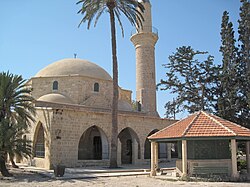
Larnaca Salt Lake is a complex network of four salt lakes of different sizes to the west of the city of Larnaca. The largest is lake Aliki, followed by lake Orphani, lake Soros and lake Spiro. They form the second largest salt lake in Cyprus after the Limassol Salt Lake. The total surface area of the lakes adds up to 2.2 km2 and being just off the road leading to Larnaca International Airport, the lake is one of the most distinctive landmarks of the area. It is considered one of the most important wetlands of Cyprus and it has been declared a Ramsar site, Natura 2000 site, Special Protected Area under the Barcelona Convention and an Important Bird Area (IBA). It is surrounded by halophytic scrubland and on its bank lies the Hala Sultan Tekke, one of the holiest of shrines within Ottoman Islam. It houses the tomb of Umm Haram, Muhammad's 'wet-nurse'.
Plan Larnaca
The Hala Sultan Tekke Excavation Site offers a fascinating glimpse into Cyprus's distant past, revealing archaeological remains from various periods. Here, you can wander among the ruins of ancient structures, see various artifacts uncovered during excavations, and imagine the life that took place here thousands of years ago.
Plan Larnaca

The Zenobia wreck lies in the Mediterranean off Larnaca, Cyprus: the remains of a Swedish-built RO-RO ferry launched in 1979, which went down in 1980 after turning over. Lying on its port side about 42 metres down, it has been ranked by The Times and others among the ten best wreck dives anywhere.
Plan Larnaca
Lefkara village is a Cypriot village renowned for its lace, known as lefkaritika, and its silver handicrafts. The village's name is derived from the Greek words "lefka" and "ori," meaning "white mountains," referring to its silica and limestone hue.
Plan LarnacaWant all of these sorted into days?
MupDay splits them by proximity and real opening hours, with no zig-zag - directions from stop to stop included. All free.
Build an itinerary for Larnaca
An impressive 18th-century Ottoman aqueduct, a historical and architectural landmark.
Plan Larnaca
Choirokoitia is a Neolithic archaeological site in Cyprus, recognized as a UNESCO World Heritage Site since 1998. It stands as one of the most important and best-preserved prehistoric sites in the eastern Mediterranean, providing evidence of an organized and functional society in the form of a collective settlement with surrounding fortifications for communal protection.
Plan Larnaca
Ancient Kition, one of the ten city-kingdoms of Cyprus, is a captivating archaeological site that unveils the city's rich past. Here, you can witness the remnants of an ancient Phoenician and Greek city-kingdom that flourished on the southern coast of Cyprus.
Plan Larnaca
Kato Drys is a small village nestled in Cyprus, southwest of Larnaca. It's a peaceful and picturesque spot, offering an authentic experience of Cypriot village life.
Plan Larnaca
The Kyriazis Medical Museum, established in Larnaca, Cyprus in 2011, is sometimes referred to as the only medical museum in Cyprus. It displays medical items, books, and framed documents relating to the practice of Cypriot medicine and the history of medicine in Cyprus, from antiquity to the 20th century.
Plan Larnaca
Cape Greco, also known as Capo Greco, is a picturesque headland on the southeastern tip of Cyprus, overlooking Famagusta Bay. It lies between the popular tourist resorts of Ayia Napa and Protaras, making it a sought-after destination for visitors seeking natural beauty.
Plan Larnaca
Skala, also known as Larnaca's Turkish Quarter, is a historic neighborhood brimming with Mediterranean charm. Wander through its narrow streets, admire the traditional architecture that blends Ottoman and Greek influences, and discover small workshops and art galleries.
Plan Larnaca

Here is what 3 days in Larnaca look like when the planner builds them - arriving at noon on the first day and flying home at noon on the last. Stops are grouped by proximity so no day doubles back, and the same route can be built for any length, from two days to a week.




The route assumes the first day starts at noon, after you land, and the last ends at noon, before your flight. It is an example: with your dates the planner builds a route around your landing and your flight home, real opening hours, how you get around and your own preferences.
Church of Saint Lazarus, Larnaca Salt Lake, Hala Sultan Tekke Excavation Site, Mackenzie Beach, The Zenobia wreck, Lefkara village and 9 more. Church of Saint Lazarus: An impressive 9th-century Byzantine church, containing the tomb of Saint Lazarus.
Day 1: Kamares Aqueduct, Ancient Kition, The Zenobia wreck, Zinonos Kitieos shopping street. Day 2: Camel Park, Hala Sultan Tekke Excavation Site, Larnaca Salt Lake, Mackenzie Beach. Day 3: Church of Saint Lazarus, Larnaca Promenade (Phinikoudes), Larnaca Marina.
The itinerary for Larnaca runs through Kamares, Larnaca, City Center and Larnaca Center.
Ready to plan Larnaca?
Build an itinerary for Larnaca